We are offering regenerative medicine at our Wickenburg office. We are the only ones in Wickenburg Arizona offering this treatment with “platelet rich plasma (PRP), and regenerative medicine” at this time.

AZ Family Health - Dr. Andrew Altman DC
We help "crooked" people feel good again!
The word “fibromyalgia” might not mean that much to you, but don’t tell that to someone troubled with this condition. Fibro sufferers report chronic, achy muscular pain in numerous specific yet widely dispersed sites, predominantly the lower back, neck, shoulders, where the arm bends, upper chest and/or knees. While the precise cause of fibromyalgia remains unsure, data suggests that the immune system is involved.
So far there is no cure for fibromyalgia that is known. A study in the Journal of Manipulative and Physiological Therapeutics (JMPT) has shown that chiropractic care has provided some relief. Study participants underwent 30 chiropractic treatments combining a number of different techniques that including spinal manipulation. The outcome illustrates considerable reductions in pain intensity and enhancement in the quality of sleep and overall fatigue in nine of the 15 patients. These improvements were maintained a month after treatment. Six patients who did not respond to chiropractic care tended to be older and have more severe fibromyalgia than the other patients.
Reference: Hains G, Hains F. Combined ischemic compression and spinal manipulation in the treatment of fibromyalgia: a preliminary estimate of dose and efficacy. Journal of Manipulative and Physiological Therapeutics, May 2000: Vol. 23, No. 4, pp225-30.
I came across this information, and thought I would share it. I have worked with numerous fibromyalgia patients in Mesa and now started taking patients in Wickenburg, Arizona. I want to add, that working with fibro patients is different… what I mean, what works one day may not work the next. The doc has to be on top of his game and pay attention to his/her patient. There has to be great communication between the patient and the doctor. For example, you think your treatment is making a difference, you see a light at the end of the tunnel, and out of nowhere your body takes a left turn away from the light. Unlike most chiropractic patients, these special cases require special handling. Take ice for example, I love using ice in my practice, but fibro patients, well let’s just say they are not fond of it. They might be willing to get their teeth drilled to forgo it… (Then again, I’ve also had to treat several of my fibro patients for TMJ problems). So, back on track… Ice, if you have fibro and can put ice on, even for a short time, it seems to help with the treatment. If you can’t, then don’t do it, there are other therapies that I also use, such as ultra sound. In addition to chiropractic adjustments and ice, fibromyalgia can be improved with diet and exercise, but that is a subject for another article. If you are suffering from fibro or TMJ don’t hesitate to make an appointment. Relief could be just around the corner.
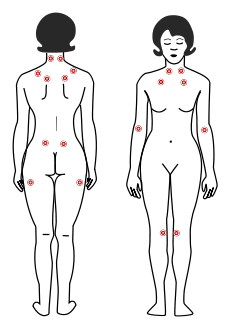 One way to test if your pains are fibromyalgia is to press these common pain points. If more than just a couple hurt, chances are you have fibro.
I had a patient that was going to cancel her appointment with me because she had a terrible pains in her jaw. Having her mouth open for an extended period of time in the dentist’s chair can cause that. She was afraid that being face down on an exam table would not be the best idea at this time. You see, she was diagnosed with temporomandibular joint (TMJ) by her dentist and her endodontist.
What is TMJ?
The TMJ is the hinge joint that connects the lower jaw (mandible) to the temporal bone of the skull. The joints are flexible, allowing the jaw to move smoothly up down and side to side. If you put your fingers lightly just in front of your ears and slowly open your mouth… well that’s your TMJ moving. So every time you to talk, chew, drink or bite your little sister, that’s your TMJ at work. The attached and surrounding muscles of the TMJ control its position and movement. We all use our TMJ hundreds of times a day. About every three minutes the average person is using their TMJ.
Symptoms:
The Mayo clinic and webMD have similar information on their site as to the symptoms.
• Painand or tenderness around your jaw or ear.
• Difficult or painful to chew.
• Clicking, popping sounds when you open or close your mouth.
• Uneven bite.
• Grinding your teeth (there maybe many different reasons for that).
• Aching pain of the face and around the ears.
• Headache or migraines are common.
• Your ability to open or close your mouth has been reduced.
Simple indication test that you can do at home that you may have a TMJ problem, that you can do at home.
Conservative treatments may include:
• Magnets
• Supplements (Jeffery B. Wheaton, DDS, MD )
• Bite plates (splints, appliances).
• Chiropractics for TMJ
• Medication
• Stretching or massaging the muscles around the jaw (your doctor of choice can show you).
• Moist heat or cold packs on the face ( I prefer the cold, sometimes I have them put crushed ice in the area).
• Acupuncture
As Medline Plus stated “non-reversible treatment method, such as orthodontics or surgery, that permanently changes your bite.”
How chiropractor’s can help:
Evidence may suggest that chiropractic treatment provide the greatest satisfaction for the hands-on alternative therapies. One study revealed that chiropractic treatment using a specific adjusting instrument eased patients’ discomfort after only three visits a week for two weeks. Before treatment, patients reported TMJ-related symptoms lasting an average of eight years, but following chiropractic care, they experienced reduced pain and improvements in other symptoms, with no noted side-effects. I on the other hand (no pun intended) do not have a study to back me up, but have used an activator or my hand to adjust patients with TMJ disorders with success.
Reference: DeVocht JW, Long CR, Zeitler DL, et al. Chiropractic treatment of temporomandibular disorders using the Activator adjusting instrument: a prospective case series.
Journal of Manipulative and Physiological Therapeutics 2003 Sep;26(7):421-5.
Journal of Orofacial Pain. 2003 Summer;17(3):224-36.
The Dental-chiropractic Cotreatment of Structural Disorders of the Jaw and Temporomandibular Joint Dysfunction
J Manipulative Physiol Ther 1995 (Sep); 18 (7): 476–481
Chiropractic Manipulation of Anteriorly Displaced Temporomandibular Disc With Adhesion
J Manipulative Physiol Ther 1995 (Feb); 18 (2): 98–104
I wrote this and posted it on the Examiner (http://www.examiner.com/article/tmj-pain-be-gone (July 8th, 2010), but seeing so many advertizements I found it hard to read.
According to the Mayo Clinic; there is no cure. The treatment goal is to reduce the duration and decrease the pain according to them.
Said to be the most painful types of headache. A stabbing pain usually lasts between 15 minutes and two or three hours. Affects one side of the head, usually behind or in and around one eye.
It may radiate to the forehead, temple, nose, cheek, or upper gum on the affected side. The scalp may be tender, and the pulsing in the arteries often can be felt.
A striking feature of cluster headache is that the attacks occur in recurring patterns, or as they say… clusters, that gives its name.
Frequent attacks that occur in recurring patterns, may last from weeks to months, with periods of remission. The pattern maybe different from one person to the next, but most have them seasonal and one episode period year.
There is a remission period, and that too, varies from person to person. This could be months or years.
Cluster headaches have been linked with people that smoke and drink alcohol frequently. Increased sensitivity to alcohol and nicotine should be a given. Small amounts of alcohol can set off a headache. During a remission period a person may consume alcohol without even aggravating a headache.
Other Treatments:
Operating on the trigeminal nerve to relieve symptoms in some people. A calcium channel blocker, also used to treat high blood pressure, may help prevent or reduce the frequency of cluster attacks. I for one … Will try to avoid surgery till I have tried other alternatives. But that is a personal choice.
Treatment suggested:
In my opinion, headaches of these types have a common ingredient. There seems to be pooling or an increase amount of blood in the brain that may cause this pain.
I found that my patients have responded well to my treatment, adjustments in the upper cervicals and has decreased the frequency of these headaches as well.